

Why your career isn’t supposed to make sense (until later)
On following the thread, even when it looks like you’re lost

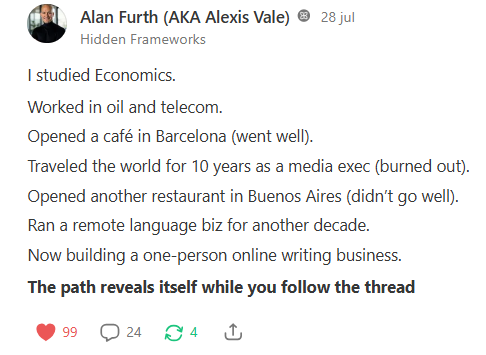
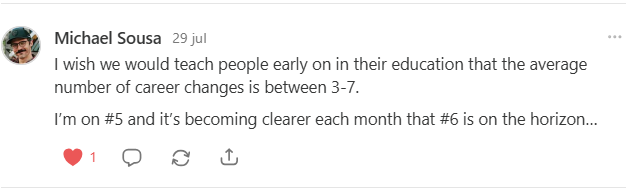
Michael Sousa left a comment on one of my notes: the average person will have 3–7 career changes in their lifetime.
Think about that for a second.
Not 3–7 jobs.
3–7 careers.
And yet, we’re told from the time we can spell “résumé” that a career should be a straight line: pick the right major, land the right entry job, climb the ladder, stay the course. If you jump off that line, you’ve failed.
But here’s the thing: every time I’ve jumped, the leap looked like chaos in the moment, and like design in hindsight.
The zig-zag isn’t the detour.
It’s the design.
The myth of the straight line
The straight-line career path is one of our culture’s great fairy tales.
Step 1: Discover your passion early.
Step 2: Devote your life to it.
Step 3: Become a stable adult who radiates expertise, authority, and LinkedIn-approved success.
It’s tidy, efficient, easy to put in a career-services brochure.
But real life?
Messy, non-linear, hard to package.
The pressure to stick to one path creates shame when you don’t. People feel defective for pivoting, restless for wanting something else, anxious when they realize the ladder they’re climbing is leaning against the wrong wall.
That’s not failure. That’s just reality.
The straight line is comforting to imagine, but in practice, it becomes a prison.
Life makes sense backwards
Kierkegaard wrote: “Life can only be understood backwards; but it must be lived forwards.”
At the time, none of my pivots looked noble or strategic. Leaving oil for media, media for restaurants, restaurants for language services… it felt like chaos, not clarity.
But now? I can see the thread.
Every industry taught me something essential. Every pivot that felt like a collapse was actually a reorientation.
Your nervous system craves certainty in the moment, but meaning only emerges in hindsight. That’s why we panic when we can’t see the plan. The truth is, there isn’t one.
The thread reveals itself backwards.
The Tao of detours
The Taoists had a word for this: wu wei. Effortless action. Moving with the current instead of against it.
Careers built on wu wei don’t look straight. They look like detours.
The restaurants I opened—some failed, some survived. At the time, I thought those failures were dead ends. In reality, they were the ground where resilience took root, lessons I use now as a solopreneur.
The detour was the direction.
Life doesn’t need your master plan. It needs your willingness to follow where the current leads.
Multipotentialites and modern reality
The writer Emilie Wapnick has a name for people who zig-zag: multipotentialites.
People wired to do many things well, not just one.
Turns out the average isn’t “pick a lane and stay put.” It’s 3–7 careers. That’s the data.
A Anna Mackenzie writes in her excellent piece on portfolio careers, building a body of work across different passions isn’t a detour—it’s a design. Her “career pie” evolves with her values, proving that zig-zags aren’t mistakes but flexible architecture.
So if you’ve been calling yourself scattered, restless, unfocused… stop.
You’re living the statistical norm.
And it’s not a bug. It’s a feature.
Multipotentialites bring adaptability, creativity, and cross-pollination. They weave perspectives that specialists can’t. The world needs them.
What looks like a zig-zag up close becomes a tapestry in the long run.
Integration, not linearity
Your career isn’t supposed to be linear. It’s supposed to be integrative.
Oil, media, restaurants, language services, writing. None of those paths canceled the others.
They layered. They stacked. They trained me in ways I couldn’t have predicted.
The myth says: coherence comes from staying in one lane.
The truth is: coherence comes from integrating many lanes into one life.
And if you need proof, look at AI. As Alex McCann points out, it can dazzle in isolated domains, but it stumbles when asked to connect them. Which is why, more than ever, the archetype of the renaissance worker is essential:
AI can paint and it can engineer, but it struggles to use engineering insights to revolutionise painting. It can write poetry and analyse markets, but it misses the poetic truth that explains market behaviour.
…That synthesis between unrelated domains—that’s what remains uniquely human.
What feels like wasted years are actually the raw material of your uniqueness.
How you know it’s alive
So if your career feels like a zig-zag, congratulations: you’re not broken. You’re human.
You won’t understand it as it happens. You’re not supposed to.
The plan only appears when you look back.
The thread doesn’t run straight. It winds.
That’s how you know it’s alive.
I think our careers, the more they vary from what is out there, the more they deviate from the standard paths, the more it resembles the life you were meant to live. However, that also means life becomes more challenging as you find your way.
I love this! Yes to nontraditional paths.